
Note: This is a plain-English guide, not legal advice. Illinois cottage food rules are set by state law but administered county by county. Confirm details with the Illinois Department of Public Health cottage food page and your own local health department before you start selling.
Do you need a license to sell baked goods in Illinois?
No — Illinois does not issue a cottage food license, and there is no routine kitchen inspection. But "no license" is not the same as "no paperwork." Selling baked goods in Illinois legally requires two separate steps.
1. Register with your local health department. Section 4(b)(1.3) of the Food Handling Regulation Enforcement Act (410 ILCS 625/4) requires a cottage food operation to register with the local health department for the unit of local government where it is located. If a county has no health department, that county must contract with an adjacent county's department to handle registration.
2. Become a certified food protection manager (CFPM). This is the requirement bakers most often miss. Section 4(b)(6) states plainly that "a person preparing or packaging a product as part of a cottage food operation must be a Department-approved certified food protection manager." This is the manager-level certification — not the shorter food handler card.
Your kitchen is only inspected in specific circumstances: under 410 ILCS 625/4(d), a health department may inspect after a consumer complaint, a foodborne illness outbreak, or reason to believe a product is misbranded or adulterated.
| Requirement | Illinois rule | Source |
|---|---|---|
| License | Not required | 410 ILCS 625/4 |
| County registration | Required, annual | 410 ILCS 625/4(b)(1.3), (c) |
| Registration fee | Set locally, capped at $50 | 410 ILCS 625/4(c) |
| Food safety training | Certified food protection manager | 410 ILCS 625/4(b)(6) |
| Certificate validity | 5 years | IDPH CFPM/FSSMC page |
| Annual sales cap | None | Home-to-Market Act, PA 102-0633 |
| Routine inspection | No — complaint-triggered only | 410 ILCS 625/4(d) |
| Out-of-state shipping | Prohibited | 410 ILCS 625/4(b)(12) |
Registering with your county health department
Illinois writes the rules at the state level and enforces them at the county level. That split is the single most confusing thing about the Illinois cottage food law, so here's the structure in plain terms.
The state sets what you can sell. The prohibited-foods list, labeling text, shipping rules, and the CFPM requirement are identical in every Illinois county.
Your county handles the paperwork. You register with the health department for the local government where your kitchen is — not where you sell. Section 4(b)(1.3) explicitly says you may register in one place and sell outside that jurisdiction, so a Peoria County registration lets you sell at a market three counties over.
The fee is capped, not fixed. Under 410 ILCS 625/4(c), a local health department "may impose a fee not to exceed $50," and registration must be completed annually. Some counties charge the full $50, some charge less. Because these amounts change and aren't published in one central place, look yours up on the IDPH local health department directory rather than trusting a number you read on a blog.
Expect a self-certification checklist. The same subsection lets a local health department "establish a self-certification program for cottage food operators to affirm compliance." In practice that means a form where you attest your kitchen and process meet the law. Will County, for example, asks for a registration application plus a Cottage Food Home Self-Certification Checklist before approving you to sell.
Chicago is its own jurisdiction. If your kitchen is in Chicago, you register with the Chicago Department of Public Health, not Cook County. Chicago also maintains its own food service sanitation certification program separate from the statewide ANSI-accredited route.
Getting your certified food protection manager certificate
To certify, you complete an ANSI-accredited CFPM course and pass the exam. IDPH notes that accredited courses may be available online, through local providers, or through some local health departments, and that certificates are valid for five years. IDPH does not set the price — courses are sold by private accredited providers, so cost varies by provider and format. Budget for a course plus a separate proctored exam fee, and get certified before you file your registration, since many counties want the certificate attached to the application.
What you can (and can't) sell
Illinois works from a prohibited list, not an approved list. If a food isn't banned and isn't a time/temperature control for safety (TCS) food, you can generally make it. That's more permissive than most states.
Explicitly prohibited under 410 ILCS 625/4(b)(1.5):
- Meat, poultry, fish, seafood, or shellfish
- Dairy — except as an ingredient in a non-TCS baked good or candy (such as caramel), or as an ingredient in a baked good frosting such as buttercream
- Eggs — except as an ingredient in a non-TCS food, or in a baked good frosting, if the eggs are not raw
- Pumpkin pies, sweet potato pies, cheesecakes, custard pies, creme pies, and pastries with TCS fillings or toppings
- Garlic in oil, unless acidified
- Low-acid canned foods, sprouts, most cut leafy greens
- Cut or pureed fresh tomato or melon, dehydrated tomato or melon, frozen cut melon
- Wild-harvested, non-cultivated mushrooms
- Alcoholic beverages and kombucha
Two rules that matter for bakers specifically:
- Buttercream is fine. Unlike states that restrict frosting recipes, Illinois permits dairy and non-raw eggs as frosting ingredients by name in the statute.
- Alcohol as an ingredient is fine. Section 4(b)(13) allows alcohol for making extracts like vanilla, or as an ingredient in baked goods, as long as the result isn't meant to be drunk.
Baked goods containing cheese get extra scrutiny: under 4(b)(4), a local health department may require you to submit the recipe to a commercial laboratory, at your expense, to verify it isn't potentially hazardous.
Where and how you can sell
Illinois cottage food must be sold directly to consumers for their own consumption, not for resale. You cannot wholesale to grocery stores, restaurants, or any retail food establishment. Within that limit, the permitted channels listed in 410 ILCS 625/4(b)(11) are broad:
- Farmers' markets, including mobile farmers markets
- Fairs, festivals, public events, or online
- Pickup from your private home or farm, if not prohibited by a local law that applies equally to all cottage food operations
- Delivery to the customer
- Pickup from third-party private property, with the property holder's consent
Shipping is allowed inside Illinois. Section 4(b)(12) permits shipping of non-TCS foods only, prohibits shipping out of state, and requires each shipped product to be "sealed in a manner that reveals tampering, including, but not limited to, a sticker or pop top."
You also need a point-of-sale notice. Section 4(b)(10) requires prominent notice reading: "This product was produced in a home kitchen not inspected by a health department that may also process common food allergens." At a physical table that means a placard; online it must be a message on your sales interface at the point of sale. If you're building a storefront, plan that disclosure into the checkout page — our guides to selling baked goods online and building a home bakery website cover where it fits.
How to label your products
Every Illinois cottage food product must be prepackaged with a prominent label carrying all seven items from 410 ILCS 625/4(b)(7):
- The name of the cottage food operation and the unit of local government where it's located
- Your registration number from the certificate of registration, plus the name of the municipality or county where you registered
- The common or usual name of the product
- All ingredients, including colors, artificial flavors, and preservatives, in descending order by weight
- This exact phrase in prominent lettering: "This product was produced in a home kitchen not inspected by a health department that may also process common food allergens. If you have safety concerns, contact your local health department."
- The date the product was processed
- Allergen labeling per federal requirements
Note what's different here from most states: Illinois requires a registration number and a processed-on date on every label, and does not require a net weight statement. If a product is genuinely difficult to package or label, 4(b)(9) lets the local health department where the product is sold grant permission to sell it unpackaged with other prominent written notice instead.
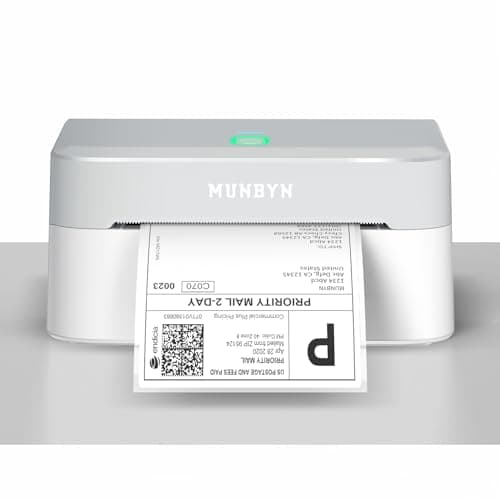
The date requirement is what makes hand-written labels painful — every batch needs a new one. A thermal label printer handles variable dates without ink or reprinting costs:
For a walkthrough of building the label itself, see how to label cottage food baked goods.
How much can you make?
There is no limit. This is the headline of the Illinois cottage food law and the reason Illinois is one of the best states in the country for scaling a home bakery.
Before 2022, Illinois capped cottage food gross sales. The Home-to-Market Act (Public Act 102-0633), effective January 1, 2022, struck that provision — the subsection that held the cap now reads simply "(1) (Blank)" in the current text of 410 ILCS 625/4. No dollar figure replaced it.
The bottom line: your ceiling in Illinois isn't revenue, it's the direct-to-consumer restriction and the prohibited-foods list. If you want to wholesale to a coffee shop or make cheesecakes, that's when you move into a licensed commercial or shared-use kitchen — not when you cross a sales number.
With no cap in the way, pricing becomes the thing that limits you. Our cottage bakery pricing formula shows how to price for margin rather than volume, and consistent portioning is what makes those margins hold up batch to batch:
How to start, step by step
- Check your menu against the prohibited list. Cheesecakes, custard and creme pies, and pumpkin pie are out. Cookies, breads, bars, and buttercream-frosted cakes are in.
- Earn your CFPM certificate. Take an ANSI-accredited certified food protection manager course and pass the exam. It's valid five years. In Chicago, use the city's certification program.
- Find your local health department on the IDPH directory and ask for their cottage food registration packet.
- Register and pay the fee — no more than $50 by statute — and complete any self-certification checklist. Renew annually.
- Design compliant labels with your registration number, ingredients, allergens, the required home-kitchen disclosure, and a processed-on date.
- Prepare your point-of-sale notice — a placard for markets, a checkout message online.
- Start selling direct to consumers, shipping only non-TCS products and only within Illinois.
For the equipment side of setup, see essential baking tools for starting a home bakery and our home bakery startup cost breakdown.
Related reading
- Cottage food laws by state: 2026 guide — how Illinois compares to Michigan, California, Texas, and more.
- Cottage food permit: how to get one in your state — how county registration compares to permit and no-permit states.
- How to label cottage food baked goods — building a label that satisfies your state's disclosure rules.
- How to price baked goods: a cottage bakery formula — pricing for profit when there's no sales cap holding you back.
- How much does it cost to start a home bakery? — real 2026 budgets from lean to pro.
What to do next
- How to take orders for a home bakery — the intake workflow you'll want before your first market.
- How to sell baked goods online — make the most of Illinois's online and in-state shipping allowance.
- Best bakery packaging for small businesses — tamper-evident boxes and bags that meet the shipping seal rule.
- Essential baking tools for starting a home bakery — the equipment list once you're registered.
- Home bakery insurance: real 2026 costs — not required by the Home-to-Market Act, but required by most market organizers.
Affiliate disclosure
Baker Setup is reader-supported. When you buy through links on our site, we may earn an affiliate commission at no extra cost to you. We only recommend products we've researched against the field — never sponsored placements.