
Note: This is a plain-English guide, not legal advice. Federal food-labeling rules (FDA, 21 CFR 101) set the baseline, but each state's cottage food law adds its own disclaimer wording and type-size rules. Always confirm the exact requirements with your state's Department of Agriculture or Health before you print.
A cottage food label is the printed information panel that every home-baked product sold to the public must carry. It is not decoration — it is a legal document. Get it right once, build a template, and every future batch takes seconds to label correctly.
What are the 6 mandatory cottage food label elements?
In most states, a compliant cottage food label carries these six elements. Treat this as your pre-print checklist — if any one is missing, the label fails. (Some states differ: Minnesota, for instance, also requires the date the food was made.)
- Product name — the common name of the item.
- Ingredient list — every ingredient, in descending order by weight.
- Net weight — the finished product's weight, in US and metric units.
- Business name and address — who made it and where.
- Allergen declaration — the 9 major FALCPA allergens present.
- State disclaimer — the "made in a home kitchen" statement.
1. Product name
State the common or usual name of the food, in plain English. "Chocolate Chip Cookies," not "Grandma's Famous Bites." The name has to tell a buyer what the product actually is — a fanciful brand name can appear too, but it cannot replace the common name.
2. Ingredient list
List every ingredient in descending order by weight, using common names a shopper recognizes ("sugar," not "sucrose"). The ingredient present in the largest amount comes first; the smallest comes last.
For compound ingredients — items made of several sub-ingredients, like chocolate chips — break out the sub-ingredients in parentheses. Example: chocolate chips (sugar, chocolate liquor, cocoa butter, soy lecithin). This is where hidden allergens like soy often live, so it matters.
3. Net weight
Declare the net weight of the finished, baked product, and list it in both US customary and metric units: Net Wt 15 oz (425 g). "Net" means the food only — it excludes the box, bag, ribbon, and any packaging.
Here is the mistake bakers make most: they weigh the dough, not the baked result. A 24 oz ball of cookie dough bakes down to roughly 20 oz as moisture evaporates. Weigh after baking, when the product has cooled. Federal rules (21 CFR 101.7) place the net-quantity statement in the bottom 30% of the principal display panel.
4. Business name and physical address
Print the name of your business and a physical address — street, city, state, and ZIP. This lets a customer (or an inspector) trace the product back to you. Some states let you omit the street address if your business is listed in a phone directory, and some require a permit or registration number alongside it. Check your state's rule.
5. Allergen declaration
You must declare any of the 9 major food allergens the product contains. There are two compliant methods, and you pick one:
- In-line parenthetical: name the allergen source right after the ingredient —
flour (wheat),lecithin (soy). - "Contains:" statement: a separate line after the ingredient list —
Contains: wheat, milk, eggs, soy.
Any of the nine allergens must be declared when it's used as an ingredient — even a small amount. Unintentional cross-contact is different: "may contain" advisory statements (for traces from shared equipment) are voluntary and do not substitute for a required declaration of an allergen you actually put in the recipe.
6. The cottage food disclaimer
Nearly every state requires a disclaimer telling buyers the food was made in an uninspected home kitchen — commonly a "made in a home kitchen" statement. This is the single most-forgotten element, and it is the one an inspector checks first.
The exact sentence and required type size vary by state, so we've built a comparison table further down. Do not guess the wording — copy your state's exact required text.
What are the 9 major food allergens you must declare?
The United States recognizes 9 major food allergens under FALCPA. Originally the law named 8, established in 2004: milk, eggs, fish, crustacean shellfish, tree nuts, peanuts, wheat, and soybeans. Sesame became the 9th major allergen through the FASTER Act — signed April 23, 2021, with labeling required as of January 1, 2023.
This is where older label guides get you in trouble: many still list only 8 allergens and omit sesame. If your recipe uses tahini, sesame seeds, or a sesame-topped bun, sesame must be declared like any other major allergen.
| Allergen | Common baking sources |
|---|---|
| Milk | Butter, cream, whey, casein |
| Eggs | Whole eggs, egg wash, meringue |
| Fish | Rare in baking; some sauces |
| Crustacean shellfish | Rare in baking |
| Tree nuts | Almond flour, walnuts, pecans |
| Peanuts | Peanut butter, peanut flour |
| Wheat | Flour, vital wheat gluten |
| Soybeans | Soy lecithin, soybean oil |
| Sesame (since 2023) | Tahini, sesame seeds, buns |
The bottom line: if any of these 9 is in the product, it goes on the label — either parenthetically or in a "Contains:" line. A missing sesame declaration is now one of the fastest ways to fail a label review.
A cottage food label template you can copy
A cottage food label template is a reusable block with the six elements in a fixed order. Fill in the blanks per product and print. Here's the copy-ready structure:
[PRODUCT NAME]

Ingredients: [ingredient, ingredient, ingredient — descending
by weight; sub-ingredients in parentheses]

Contains: [allergen, allergen]

Net Wt [X oz] ([Y g])

[Your Business Name]
[Street, City, State ZIP]

[Your state's required "made in a home kitchen" disclaimer]
And here's the same template filled in for a real product — chocolate chip cookies made in California:
Chocolate Chip Cookies

Ingredients: enriched flour (wheat), butter (milk), brown sugar,
chocolate chips (sugar, chocolate liquor, cocoa butter, soy
lecithin), granulated sugar, eggs, vanilla extract, baking soda,
salt

Contains: wheat, milk, eggs, soy

Net Wt 8 oz (227 g)

Sweet Layers Bakery
1450 Maple Ave, Sacramento, CA 95818

Made in a Home Kitchen
CA Cottage Food Operation Permit #[your permit number]
Because this example is a California operation, it includes the CFO registration/permit number — California (HSC §114365.5) requires it directly on the label. Replace [your permit number] with the number issued by your county environmental health department. Most states do not require a permit number on the label, so check your state's rule before adding one — see the state disclaimer table below.
Use this element-by-element table as your final proof before printing:
| Element | Example text | Common mistake |
|---|---|---|
| Product name | Chocolate Chip Cookies | Using only a fanciful brand name |
| Ingredients | flour (wheat), butter (milk)… | Not ordering by weight |
| Net weight | Net Wt 8 oz (227 g) | Weighing dough, omitting metric |
| Name & address | Sweet Layers Bakery, Sacramento, CA | No physical address |
| Allergens | Contains: wheat, milk, eggs, soy | Listing only 8 allergens |
| Disclaimer | Made in a Home Kitchen | Forgetting it entirely |
Print your own vs. buy pre-made labels
Direct answer: DIY thermal printing is the cheapest per label once you're doing volume; printable Avery-style sheets suit low volume or full-color branding; pre-made labels are for one-off gifts. The right choice depends on how many labels you print a week and whether you need color.
| Method | Upfront cost | Cost per label | Best for | Durability |
|---|---|---|---|---|
| Thermal printer | $80–$150 | ~$0.02–0.05 | Volume, black-and-white | Waterproof rolls |
| Inkjet/laser sheets | $0 (own printer) | ~$0.10–0.30 | Low volume, color | Depends on stock |
| Pre-made labels | N/A | Highest | One-off gifts | Varies |
Thermal label printers (no ink)
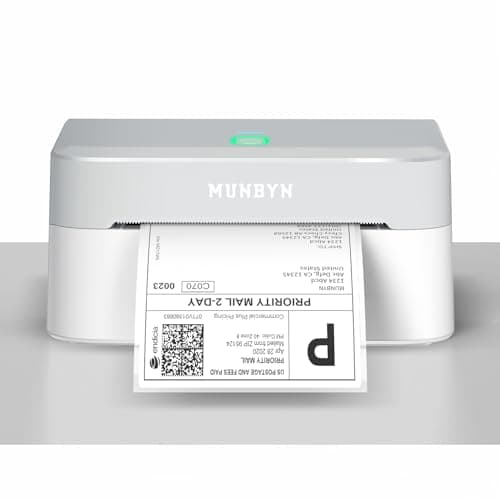
A thermal label printer is the workhorse of a busy home bakery: it prints on heat-sensitive label rolls, so there is no ink or toner to buy or run out of mid-batch. The Munbyn RW403B prints 4x6 labels wirelessly and takes smaller die-cut roll sizes bakers use for jars and cookie bags.
If you want a Wi-Fi/AirPrint alternative, the Rollo and DYMO LabelWriter lines fill the same niche — compact desktop thermal printers with wide label-size support. Any of the three earns its place as a best label printer for home bakery use once you're printing more than a handful of labels a week.
Printable label sheets (inkjet or laser)
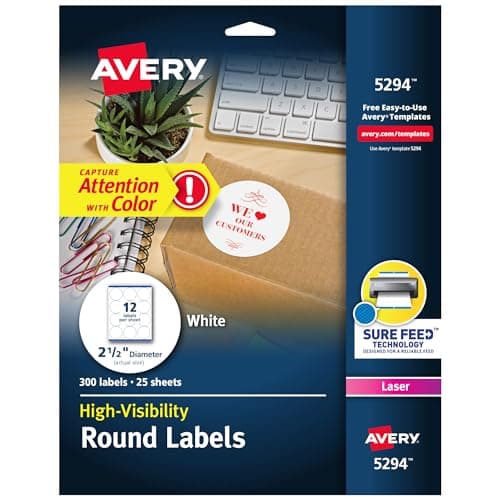
If you print in small batches or want full-color branding, printable label sheets run through the inkjet or laser printer you already own. Avery-style round or rectangle sheets come in templates you can design in a word processor or Avery's free tool.
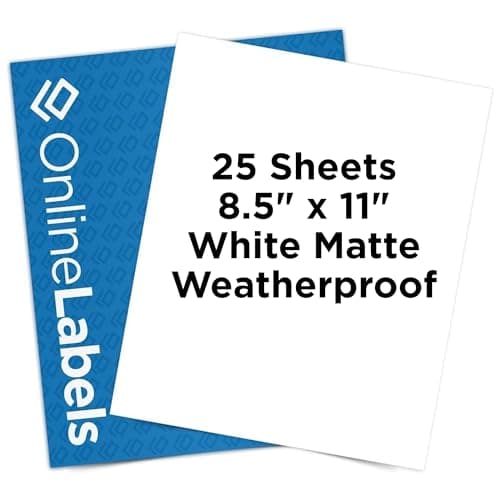
One caveat for baked goods: standard paper labels smear when they meet butter, grease, or a chilled surface's condensation. Use waterproof or weatherproof label stock so your ingredient list and disclaimer stay legible from oven to freezer.
Getting net weight right
Your scale is a compliance tool, not just a baking tool. Net weight labeling of baked goods requires an accurate reading of the finished product, and a printed label with the wrong weight is a labeling violation. A digital kitchen scale that reads in both grams and ounces lets you fill in the dual oz (g) declaration directly.
How does the "made in a home kitchen" disclaimer differ by state?
Direct answer: every state mandates a disclaimer, but the exact required sentence — and the minimum type size — differs by state. Five of the six label elements are essentially federal and consistent; the disclaimer is the one that changes when you cross a state line.
Use the table below as a starting point, then open the linked guide to copy your state's exact statutory wording. This is the hub of our cottage food laws by state cluster — start there if your state isn't listed.
| State | Disclaimer wording (paraphrased) | Full guide |
|---|---|---|
| California | "Made in a Home Kitchen" — in 12-point type | California's Class A & B cottage food rules |
| Texas | "This food is made in a home kitchen and is not inspected by the Department of State Health Services…" | what Texas lets you sell |
| Florida | "Made in a cottage food operation that is not subject to Florida's food safety regulations." | Florida cottage food law |
| Michigan | "Made in a home kitchen that has not been inspected by the Michigan Department of Agriculture and Rural Development." | Michigan home bakery rules |
| Your state | Verify wording and type size locally | cottage food laws by state |
Because the wording is statutory, paraphrasing it on your actual label is a mistake — reproduce the exact sentence your state prescribes.
Common cottage food labeling mistakes
Most failed labels come down to the same short list of errors. Check yours against each:
- Weighing the dough, not the finished product. Bake first, cool, then weigh.
- Forgetting the disclaimer. The most-missed element on the label.
- Making a nutrition or health claim. Cottage food is generally exempt from a Nutrition Facts panel — but the moment you claim "low sugar," "high protein," or "heart healthy," you trigger the requirement. Skip health claims.
- Type too small to read. Many states require a minimum 10- or 12-point type. Illegible is non-compliant.
- Omitting the physical address. A business name alone is not enough.
- Listing only 8 allergens. Add sesame — it's been required since January 1, 2023.
Fix these six and you clear the vast majority of label reviews.
Related reading
- Cottage food laws by state: 2026 guide — the hub that compares licenses, sales caps, and labeling across 12 states.
- California cottage food law: Class A & B explained — the two-tier labeling rules in the most-regulated state.
- Texas cottage food law: what you can sell — Texas's disclaimer wording and product list.
- Florida cottage food law: sell baked goods from home — Florida's $250,000 cap and its exact disclaimer.
- Michigan cottage food law: 2026 rules — Michigan's home-bakery labeling and sales rules.
What to do next
Your next step is one label. Copy the template above, drop in your product's ingredients and finished net weight, and paste in your state's exact disclaimer — verified against the matching guide, not from memory. Then pick a printing method: a thermal printer for volume, waterproof sheets for color.
Once your labels are compliant, two things follow naturally. First, price your baked goods with a simple formula so every labeled item clears a profit. Then sell your baked goods online — accurate labels are a prerequisite for shipping and pickup orders alike.
Affiliate disclosure
Baker Setup is reader-supported. When you buy through links on our site, we may earn an affiliate commission at no extra cost to you. We only recommend products we've researched against the field — never sponsored placements.