
Why most home bakers underprice (and how much it costs)
The single biggest reason home bakeries fail isn't quality — it's pricing. The typical pattern: a baker quotes $40 for a custom cake that costs $8 in ingredients, takes 3 hours of work, and uses $3 in packaging. They net $29 for an afternoon of effort, which is $9.66/hour. After accounting for overhead, the real rate drops to about $5/hour.
This usually traces to three causes:
- Grocery store comparison. A grocery store sells a cake at retail with industrial-scale margins, $0.50/hour labor cost, and centralized packaging. You can't match that price and run a profitable home business. You're not competing on price; you're competing on quality and customization.
- Free labor. Most home bakers don't count their own time. If they did, they'd realize they could earn more at any part-time retail job — without the ingredient costs and customer service.
- Invisible overhead. Bag of flour you tossed because it sat too long? Cost. Parchment paper, oven gas, electricity for the stand mixer, refrigerator dedicated to wedding cake storage? All cost. Failed bake you ate instead of selling? Cost.
The fix is the formula below. Run every order through it before quoting.
The formula
Sale price = (Ingredient cost × 3) + (Labor hours × $15–$25) + Packaging cost
Component breakdown:
- Ingredient cost × 3. The 3x multiplier absorbs overhead — utilities, equipment depreciation, packaging buffer, spoilage, the bag of sugar you didn't use the bottom of, the kitchen towels you destroyed. Industry-standard markup for cottage bakeries. Some pros use 4x.
- Labor. Pay yourself $15–$25/hour at minimum, depending on skill level. New bakers: $15. Bakers with 2+ years: $20. Specialty/decorator skills: $25+. This is your hourly rate, not a wage you pay someone else.
- Packaging cost. Box + label + ribbon + tissue paper. Don't estimate — actually total it up the first time, then keep a reference number per package size.
The number this produces will feel uncomfortably high your first few times running it. That feeling is the gap between what you've been charging and what you should be charging.
Worked example: a 6-inch buttercream birthday cake
| Component | Calc | Cost |
|---|---|---|
| Flour, sugar, butter, eggs | (recipe inputs) | $4.50 |
| Buttercream + food coloring | $1.50 | |
| Ingredient subtotal | $6.00 | |
| × 3 overhead multiplier | $18.00 | |
| Mixing + baking + cooling | 1.0 hour @ $20 | $20.00 |
| Crumb coat + decoration | 1.5 hour @ $20 | $30.00 |
| Labor subtotal | $50.00 | |
| 8-inch cake box + label + tissue | $3.00 | |
| Total (before custom premium) | $71.00 | |
| Custom design premium (+30%) | $92.00 |
The formula reveals what the "I'd just charge $35" instinct misses. If you give away custom work for $35, you're paying the customer $36 of your own labor to bake their cake. Multiply by 10 orders/month and you're losing $360/month doing skilled work.
Costing your ingredients accurately
Most home bakers wing this. Don't — it's the foundation the multiplier sits on. The process is one-time setup, then takes 2 minutes per recipe:
- Weigh every ingredient per recipe with a kitchen scale. By weight, not volume.

OXO Good Grips 11 lb Food Scale with Pull-Out Display
Baking Tools
- Pull-out display keeps readout visible even with large bowls
- 11 lb / 5 kg capacity with precise 1g increments
- Large stainless steel platform with removable tray
A scale is the single highest-leverage tool in a pricing system. Volume measurements (a "cup" of flour) vary 30%+ depending on packing. By weight you have a real number you can multiply against your bag cost.
-
Calculate cost per gram for each ingredient. Bag of King Arthur bread flour: ~$5.50 for 2.27kg → $0.00242/g. A recipe using 500g of flour = $1.21 in flour. Do this once per ingredient, keep the numbers in a spreadsheet.
-
Sum per-ingredient costs for the recipe. This is your true ingredient cost. Refresh the per-gram costs every 3 months as prices shift.
The whole spreadsheet takes an afternoon to build. After that, costing a new recipe is plugging in weights.
Time tracking: what counts as labor
Most bakers count only the visible bake. Real labor includes everything between accepting the order and handing it over:
| Task | Counts as labor? |
|---|---|
| Mixing, baking, cooling | YES |
| Decorating, packaging | YES |
| Sourcing/buying special ingredients | YES |
| Customer messages about the order | YES |
| Delivery time | YES (or charge a separate delivery fee) |
| Designing a custom topper or sketch | YES |
| Cleaning the kitchen post-bake | YES (allocate to the batch) |
| Watching the oven (idle time) | HALF |
Run a stopwatch the first few times. Most bakers discover that a "3-hour cake" is actually 5 hours when they count message threads, ingredient shopping, and cleanup.
Production cost basics: equipment-per-batch math
The ×3 multiplier covers most equipment depreciation, but for pros pricing wholesale, it's worth understanding the underlying math. A KitchenAid Artisan used 5 times a week for 5 years processes ~1,300 batches before retirement.
At a $450 mixer cost, that's $0.35/batch in equipment depreciation. Same logic applies to sheet pans:
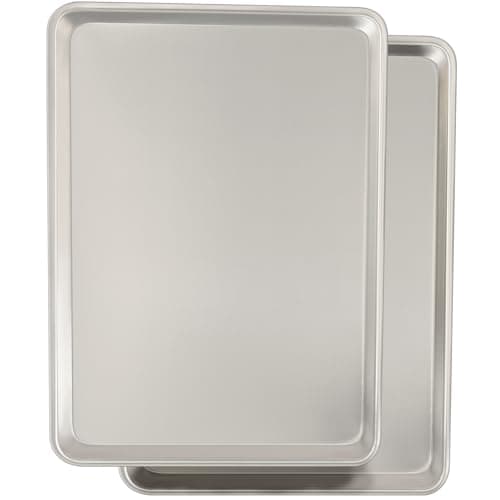
Two half-sheets at $35 total, 500 uses each → $0.07/batch. The numbers are small per item but real, and the 3x multiplier on ingredients absorbs them comfortably.
Wholesale vs retail pricing
If you sell to coffee shops, restaurants, or other businesses, they need ~50% margin to resell — meaning your wholesale price is roughly half your retail. Use this floor:
Wholesale price = (Ingredient cost × 3) + (Labor hours × $15) + Packaging
Retail price = Wholesale × 2
The lower labor rate in wholesale acknowledges that volume buyers expect lower per-unit pricing. Don't go below $15/hour wholesale — at lower rates you're funding the buyer's business with your time.
For comparison: a cookie that costs $0.40 in ingredients and 10 minutes labor:
- Wholesale: ($0.40 × 3) + ($2.50) + $0.10 = $3.80
- Retail: $3.80 × 2 = $7.60
If the coffee shop says they can only pay $2/cookie, they need to either order higher volume (lowering your per-unit time) or you should pass.
Custom and rush orders
Standard pricing assumes 7+ days lead time. Anything tighter or more complex needs a surcharge:
- Custom design / sketches / hand-piping: +25–40% on the base formula
- Rush order (under 72 hours): +25%
- Wedding cakes (delivery + setup + risk): +50–100%
- Allergen-free with separate equipment: +20% (covers the cleaning + sourcing overhead)
These aren't "extras" — they're real cost coverage. Without them you're subsidizing the special-request work with the standard work.
When to raise prices
Standard interval: every 6–12 months, automatically. Inflation alone is 3–5%/year now; ignoring that turns your real wages into pay cuts. Plus you'll get better at the work — your $20/hour year-one rate should be $25–30 by year three.
Signs you're underpricing right now:
- You're booked solid but barely breaking even
- You feel resentment doing customer work
- A part-time job would pay better hourly
- You're not buying replacement equipment when it fails
Raise prices on next month's new orders, not retroactively on existing ones. Grandfather repeat customers if you want to — but don't grandfather them forever.
What to do next
- How to take orders for a home bakery: workflow & tools — the order intake system to enforce these prices.
- How much does it cost to start a home bakery? Real 2026 numbers — your cost base for the formula above.
Related reading
- Essential baking tools for starting a home bakery — the scale and tools that make accurate costing possible.
- Best stand mixers for home bakers — the equipment-depreciation math from above made concrete.
Affiliate disclosure
Baker Setup is reader-supported. When you buy through links on our site, we may earn an affiliate commission at no extra cost to you. We only recommend products we've researched against the field — never sponsored placements.