
Note: This is a plain-English guide, not legal advice. HB 4122's changes are recent — confirm the current cap, effective date, and online-sales rules with MDARD (Michigan Department of Agriculture and Rural Development) before you start selling.
Do you need a license to sell baked goods in Michigan?
No. Michigan does not require a license, permit, or kitchen inspection from MDARD to operate a cottage food business, and there is no mandatory food-safety course (though MSU offers training that's worth taking).
The one optional step worth knowing: you can request a free registration number from the MSU Product Center. You don't need it to sell — but it lets you put that number on your labels instead of your home address, which many bakers prefer for privacy.
What you can (and can't) sell
Michigan allows shelf-stable, non-perishable foods only. The list is broad, but a couple of items are more restricted than in other states.
Allowed:
- Breads and baked goods that don't need refrigeration
- Cookies, brownies, and shelf-stable cakes
- Candy, chocolate, fudge, and truffles
- Jams and jellies, marmalades
- Honey and maple syrup
- Nut butters, vinegars, dried goods, popcorn, granola
- Fruit leathers, vegetable chips, and chocolate-covered fruit
Prohibited:
- Perishable baked goods (anything needing refrigeration)
- Most buttercream — only two specific approved recipes are allowed (listed on MDARD's page)
- Fruit butters (allowed in many states, but not Michigan)
- Pickles, salsas, sauces, ketchup/mustards, and acidified or canned foods
- Fermented foods, kombucha, juices, and carbonated drinks
- Candied apples, alcohol-containing confections, meat jerkies, and pet food
If you decorate cakes, check your buttercream recipe against MDARD's two approved formulas before you sell — this is Michigan's most-missed rule.
Where and how you can sell
This is where HB 4122 made the biggest change. Michigan cottage operators can now sell through:
- Your home, farmers markets, roadside stands, and events
- Online ordering and payment
- In-state shipping / mail order
- Third-party delivery services (e.g., DoorDash)
The rules that come with the new channels:
- Direct interaction first. For online, mail, or delivery sales, you must give the customer the opportunity to interact with you directly — in person or via a face-to-face virtual call — before they buy.
- Direct-to-consumer only. No wholesale to stores or restaurants.
- In-state only. No interstate shipping.
How to label your products
Michigan requires a complete label on every cottage food product:
- The product name
- Your business name
- Your business address (or a phone number plus your MSU-issued registration number)
- A full ingredient list
- An allergen statement — "Contains: wheat, milk, eggs…" as applicable
- The net weight / net amount
- This exact disclaimer, in at least 11-point type:
Made in a home kitchen that has not been inspected by the Michigan Department of Agriculture and Rural Development.
(For maple syrup and honey, the wording instead reads: "Processed in a facility not inspected by the Michigan Department of Agriculture & Rural Development.")
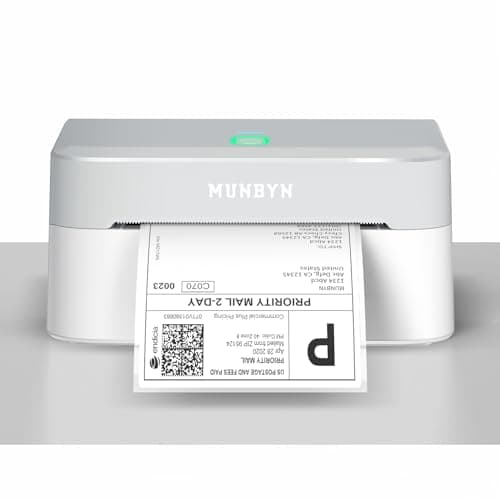
Because Michigan requires both an ingredient list and a net-weight statement, a thermal label printer is the easiest way to produce compliant, repeatable labels at home — no ink, just peel-and-stick rolls:
And an accurate kitchen scale is what makes the required net-weight figures trustworthy:
How much can you make? The new $50,000 cap
House Bill 4122 doubled Michigan's cottage food cap from $25,000 to $50,000 in gross annual sales, with the change taking effect in 2026. That's a meaningful jump — combined with the new online and shipping allowances, it makes Michigan a much more viable place to grow a home bakery than it was a year ago.
Because the effective date and exact figure changed recently, confirm the current number on the MDARD page before you bank on it. If you outgrow $50,000, the next step is a licensed commercial or shared-use kitchen.
Price your menu to make that cap worth chasing — our cottage bakery pricing formula shows how to charge for real profit, not just revenue.
How to start a cottage food business in Michigan, step by step
- Confirm your menu is compliant — shelf-stable items only, buttercream limited to MDARD's two approved recipes.
- (Optional) Get a free MSU registration number if you want to keep your home address off your labels.
- Design your labels — product name, business name, address or reg number, ingredients, allergens, net weight, and the required 11-point disclaimer.
- Set your prices to cover ingredients, packaging, and your time.
- Pick your channels — and if you sell online, build in a way for customers to interact with you directly first.
- Start selling, keeping gross sales under $50,000/year.
For the equipment side, see essential baking tools for starting a home bakery and our home bakery startup cost guide.
Related reading
- Cottage food laws by state: 2026 guide — how Michigan compares to California, Texas, and 9 other states.
- Cottage food permit: how to get one in your state — how Michigan's no-permit model compares to registration and inspection states.
- How much does it cost to start a home bakery? — real 2026 budgets from lean to pro.
- How to price baked goods: a cottage bakery formula — what to charge so your menu profits.
- Essential baking tools for starting a home bakery — the equipment list once you're cleared to sell.
What to do next
- How to take orders for a home bakery — the intake workflow you'll need from week one.
- How to build a home bakery website — make the most of Michigan's new online-sales allowance.
- Best bakery packaging for small businesses — boxes, bags, and labels that look professional.
- Home bakery insurance: real 2026 costs — not a Michigan requirement, but a condition of most market and festival booths.
Affiliate disclosure
Baker Setup is reader-supported. When you buy through links on our site, we may earn an affiliate commission at no extra cost to you. We only recommend products we've researched against the field — never sponsored placements.