
Note: This is a plain-English guide, not legal advice. Georgia's written rules are mid-transition — see the section below on why the rulebook and the actual law disagree right now. Confirm anything you're betting a business on with the Georgia Department of Agriculture cottage food program (CottageFoodInfo@agr.georgia.gov, 404-656-3627). GDA's own HB 398 update and FAQ (PDF) is the primary source for everything on this page, and HB 398 itself is the statute.
Do you need a license to sell baked goods in Georgia?
No. Georgia's cottage food law no longer requires a license, a permit, or a fee from the Georgia Department of Agriculture (GDA). Governor Brian Kemp signed House Bill 398 on May 13, 2025, and it took effect July 1, 2025.
In GDA's own words, HB 398 brought a "Removed Licensing Requirement" — cottage food operators "no longer need to obtain a license with the Georgia Department of Agriculture ('GDA') or pay a licensing fee to the state."
That is a genuinely big change. Before HB 398, a Georgia home baker had to register, pay $100 annually, list every single product on the registration form, and pass a home kitchen inspection before selling a cookie. All of it is gone.
You may still need a local business license, zoning clearance, or a DBA registration. GDA is explicit that HB 398 "does not affect general local requirements like business licensing or zoning." Call your county before you launch.
Why the official rulebook still says "license" — and why you can ignore it
Here's the wrinkle nobody explains, and it's the thing most likely to confuse you if you go looking for the primary source.
Georgia's cottage food regulations — Ga. Comp. R. & Regs. Subject 40-7-19 — have not yet been rewritten. As of this writing, that chapter still contains Rule 40-7-19-.04 Licenses and Fees, which reads "A person must not operate as a cottage food operator without registering with and obtaining a license from the Department" and sets "the annual fee for the Cottage Food License… at $100.00." It still contains Rule 40-7-19-.07 Inspections and a limitation that "no distribution or wholesale is allowed, including to hotels, restaurants, or institutions."
None of that is enforceable anymore. A statute beats a regulation. GDA said so directly in its HB 398 guidance: prior regulations "will be amended, including by repealing portions inconsistent with HB 398 like licensing requirements and more restrictive sales," and GDA "will use its enforcement discretion in the meantime when an old requirement is no longer supported by HB 398."
GDA's own website now lists the governing law as "HB 398 – Cottage Food Law – OCGA 26-2-470 et seq (Under Revision)." So if you land on a stale blog post, an old PDF, or the rules site itself and it tells you to pay $100 and book an inspection — that's the pre-July-2025 world. The bottom line: follow HB 398, not Subject 40-7-19, and re-check the rules chapter later this year once the amendments land.
What you can (and can't) sell
Georgia allows non-potentially hazardous foods only — shelf-stable products that don't need time or temperature control for safety. GDA's published cottage food product list includes:
- Loaf breads, rolls, and biscuits
- Cakes
- Pastries and cookies
- Candies and confections
- Fruit pies
- Jams, jellies, and preserves
- Dried fruits
- Dry herbs, seasonings, and mixtures
- Cereals, trail mixes, and granola
- Coated or uncoated nuts
- Vinegar and flavored vinegar
- Popcorn, popcorn balls, and cotton candy
Potentially hazardous foods disqualify you entirely. GDA lists these as including meat, poultry, fish, shellfish, eggs, milk and dairy products, cooked plant-based foods, baked potatoes, mushrooms, raw sprouts, tofu and soy-protein foods, and untreated garlic-and-oil mixtures. In practice that rules out cheesecake, cream-cheese frosting, custard and cream pies, and anything else that lives in the fridge.
Three location rules trip people up: it must be your primary residence (not a vacation or motor home), it must be the domestic kitchen (not a shed, barn, or garage), and rented or shared commercial kitchens don't qualify — those require a Food Sales Establishment license. Pet treats are also out of scope; they need a feed license from GDA's Agricultural Inputs division.
The home kitchen check GDA no longer schedules — but still expects
There is no pre-licensing inspection in Georgia anymore. That's the headline. But "no scheduled inspection" is not "no standard," and this is where new bakers get sloppy.
GDA confirms it "will still investigate consumer complaints, reports of foodborne illness, and public health emergencies." One sick customer, one angry review escalated to the state, and someone shows up. What they'd be measuring you against are GDA's Food Safety Directives in Rule 40-7-19-.08, described in the rule itself as "the minimum best practices required in the production of cottage food products."
Treat the table below as the self-inspection you now have to run yourself, because nobody is going to run it for you.
| What GDA looks at | What "passing" looks like | Common failure |
|---|---|---|
| Handwashing | Hands and exposed forearms washed before production and after anything that soils them | Washing at the same moment you're handling dough; no dedicated hand-drying towel |
| Water source | Municipal water, or a properly constructed on-site well | Using a shallow, dug, or uncapped well |
| Well testing (if applicable) | Tested at least annually for coliform bacteria and nitrates | Never tested; no records kept |
| Equipment | Ordinary domestic equipment. Commercial gear like large rotary mixers is not permitted — home sinks can't wash, rinse, and sanitize it | Buying a 20-qt floor mixer before checking |
| Storage | Ingredients and finished product stored inside the residence — kitchen, spare room, or a dry basement | Storing flour or packaging in the garage or a shed |
| Scales | A scale for verifying net contents; a legal-for-trade scale if you sell by weight | Estimating net weight instead of measuring it |
| Production space | The domestic kitchen of your primary residence | Baking at a second home or in a rented kitchen |
Your prep checklist before you take the first order: test the well if you're on one, move all bakery storage indoors, buy a scale, take the food safety course (next section), and write your labels. That's the whole list now.
One more thing that hasn't gone away: GDA states that cottage food operators must complete an ANSI-accredited food safety training program. Food Handler level is acceptable — you don't need the full Certified Food Manager credential. GDA links a directory of accredited programs from its cottage food page. It's a few hours and usually under $20.
Where and how you can sell
HB 398 widened this dramatically. Georgia cottage food operators can now sell:
- Direct to consumers — from home, at for-profit and non-profit events, and at farmers markets
- Online, within Georgia
- By mail order
- To retail food sales establishments — grocery stores, convenience stores, and restaurants
That last channel is brand new. Before HB 398, wholesale was flatly prohibited. Retailers carrying your products must display them in a separate, clearly labeled section so customers know they were made in a residential kitchen.
Two limits worth knowing:
- Local opt-out. HB 398 lets any Georgia city or county pass an ordinance prohibiting cottage food sales through third-party vendors inside its jurisdiction. Check before you pitch a local grocer. (Cities and counties can't otherwise regulate cottage food directly, and can't block commercial delivery companies from delivering cottage food items.)
- Interstate shipping is a trap. GDA warns that engaging in interstate commerce may pull you under FDA oversight, which would require a Manufactured Food Establishment License — and that license "cannot be issued for foods prepared in a domestic kitchen." Keep sales inside Georgia.
Free samples are allowed if the product stays non-potentially hazardous and properly labeled packages are on display beside the samples. Note too that individual farmers markets can still impose their own vendor rules — GDA confirms a market may require a Food Sales Establishment License as its own local policy, even though the state doesn't.
If online is your channel, our guides to selling baked goods online and building a home bakery website cover the setup.
How to label your products
Every Georgia cottage food package needs six elements:
- Business name and address of the cottage food operation — or your GDA Identification Number instead of the address
- Common name or description of the product
- Ingredients, in descending order of predominance by weight
- Net weight or net volume
- Allergen labeling, per federal requirements
- This exact statement:
MADE IN A COTTAGE FOOD OPERATION THAT IS NOT SUBJECT TO STATE FOOD SAFETY INSPECTIONS
GDA specifies the formatting precisely: all capital letters, Times New Roman or Arial, at least 10-point type, in a color that contrasts with the label background. Hand-printed labels are acceptable if they're clearly legible, in durable permanent ink, and at least as large as the required font size.
The privacy upgrade: HB 398 created an optional Identification Number for operators "uncomfortable with providing their address on labels." You request it free using the Identification Number Registration Form on GDA's cottage food page, and print it in place of your home address. If you sell online or ship, get one.
For custom cakes sold to an individual — wedding and birthday cakes — the business name, address, and the cottage food statement can go on the shipping container or on the invoice provided to the customer. Bulk-bin sales can carry the labeling on a card, sign, or booklet at the point of sale rather than on each package.
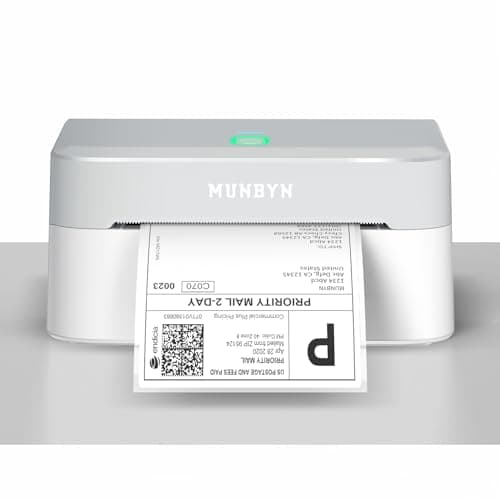
Because Georgia requires both a full ingredient list and a net-weight declaration on every package, a thermal label printer pays for itself fast — no ink, just peel-and-stick rolls you can reprint whenever a recipe changes:
And the net-weight figure on that label has to be real. Rule 40-7-19-.10 tells operators to use a scale to verify net contents, and requires a legal-for-trade scale if you sell by weight:
Our cottage food labeling guide walks through layout and allergen wording in more detail.
How much can you make?
There is no cap. GDA's FAQ states it directly: the Department "does not have any limits on gross sales or the number of units that can be produced." HB 398 removed the prior restrictions, and unlike California, Texas, or Michigan, Georgia now sets no dollar ceiling at all.
That makes Georgia one of the most growth-friendly cottage food states in the country. Your real constraints become oven capacity, hours in a day, and the product list — not a revenue number.
No cap also means no artificial reason to under-price. Work through our cottage bakery pricing formula so the volume actually converts into profit, and use the home bakery startup cost guide to size your first investment.
How to get started, step by step
- Check your menu against GDA's non-potentially-hazardous list — no refrigerated fillings or frostings.
- Call your city and county about business licensing, zoning, and any third-party-vendor opt-out ordinance.
- Complete an ANSI-accredited food safety course — Food Handler level is enough.
- Test your well for coliform bacteria and nitrates if you're not on municipal water.
- Request a free GDA Identification Number if you'd rather not print your home address.
- Build your labels — name, address or ID number, ingredients, net weight, allergens, and the 10-point all-caps disclosure.
- Buy a scale and verify your net weights before your first sale.
- Pick your channels — direct, online in-state, mail order, or retail — and start selling.
For the equipment side, see essential baking tools for starting a home bakery.
Related reading
- Cottage food laws by state: 2026 guide — how Georgia compares to California, Texas, Florida, and Michigan.
- Cottage food permit: how to get one in your state — what replaced Georgia's abolished license, and how other states handle it.
- How to label cottage food baked goods — the label anatomy, in detail.
- How to price baked goods: a cottage bakery formula — what to charge with no cap holding you back.
- How much does it cost to start a home bakery? — real 2026 budgets, lean to pro.
What to do next
- How to take orders for a home bakery — the intake workflow you'll need from week one.
- How to sell baked goods online from home — make the most of Georgia's in-state online and mail-order allowance.
- Best bakery packaging for small businesses — boxes, bags, and labels that look professional on a grocery shelf.
- Home bakery insurance: real 2026 costs — the coverage grocery buyers and market organizers expect to see.
Affiliate disclosure
Baker Setup is reader-supported. When you buy through links on our site, we may earn an affiliate commission at no extra cost to you. We only recommend products we've researched against the field — never sponsored placements.