Why a Dutch oven matters for sourdough
A home oven can't generate the steam a commercial deck oven uses to crust a loaf. The cheapest fix isn't a steam injector — it's a pre-heated cast iron pot. The dough releases its own moisture into the sealed environment for the first 20 minutes, then you remove the lid and let dry heat finish the crust.
That's the whole trick. You don't need fancy bread pans, lava rocks, or boiling water on a sheet pan. A $60 pot does it better than any of them.
What you actually need from the pot:
- Oven-safe to at least 500°F — both pot and lid handle.
- Tight-fitting lid that traps steam for the first half of the bake.
- Cast iron mass to hold heat through dough loading without crashing the oven temp.
- Sized to your loaves — too big and the dough spreads sideways instead of springing up.
Everything else (color, knob shape, "made in France" cachet) is preference, not performance.
What to look for under $100
Below $100 you're buying Lodge or Lodge-equivalent. That's not a bad thing — Lodge sells more cast iron than any other US brand, and their basics outlast pots costing five times more. A few details separate the good buys from the regrets:
- Loading ease. Loading a wet dough into a screaming-hot deep pot risks burns and deflates the boule. Shallow-base designs (Combo Cooker, Double Dutch) solve this — you score the dough on the lid (inverted), then cover with the deep half. Far safer.
- Lid clearance. Standard round 5–6qt pots have ~4 inches of lid height. Enough for most loaves; tight for high-rise boules.
- Knob temperature rating. Some enameled lids ship with a plastic knob rated to 400°F only. Useless for sourdough. Verify the spec or plan to swap for a metal knob ($8 on Amazon).
- Weight. A 6-quart enameled pot weighs 13–16 lb. If wrist strength is a factor, drop to a 5-quart or pick a bare cast iron 3qt.
The 4 best Dutch ovens for sourdough under $100
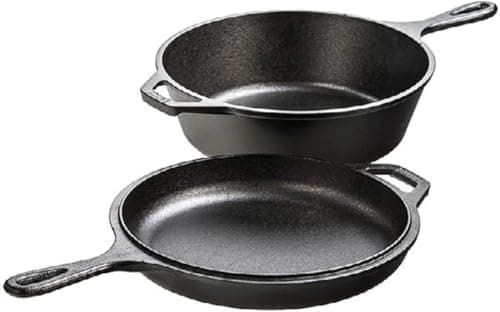
Lodge Cast Iron Combo Cooker - PFAS-Free 2-in-1 3.2 Quart Deep…
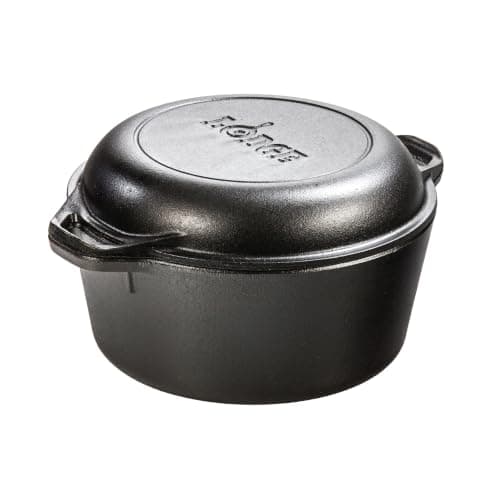
Lodge Cast Iron Double Dutch Oven 5 Quart - Pre-Seasoned 2-in-1…
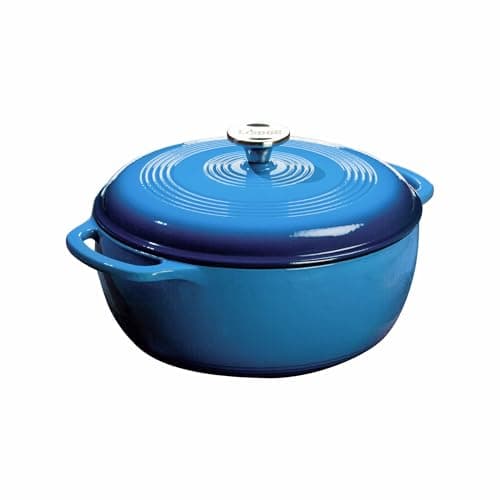
Lodge Essential Enamel Cast Iron Dutch Oven 6 Quarts - Perfect…
Top pick — Lodge Cast Iron Combo Cooker (3.2 qt)
Lodge Cast Iron Combo Cooker - PFAS-Free 2-in-1 3.2 Quart Deep Pot and 10.25 Inch Skillet Set - Dutch Oven with Skillet Lid for Sourdough, Frying, and Camping - Made in the USA
Baking Equipment
- The Ultimate 2-in-1 Cooker: This cast iron set is a kitchen powerhouse. Use the 3.2 quart deep pot for slow-simmered stews or deep frying, then flip the lid to use a standalone 10.25 inch skillet. Use them together or apart for every meal
- Master the Sourdough Crust: Professional bakers love this lodge Combo Cooker for bread. When used together, the skillet creates a tight seal that traps steam, giving your sourdough bread a superior rise and a bakery-quality, crispy crust every time
- Naturally PFAS-Free: We season our Lodge Cast Iron with 100% natural vegetable oil right at the foundry. You get an easy-release surface that improves with use, without any synthetic coatings or chemicals
The pot that sold a million sourdough bakers. The "lid" is a 10-inch skillet that flips over to become the base — so you load the dough onto the shallow skillet (where it's easy to score), then drop the deep pot on top as a steam dome. No reaching into a 500°F well with a razor.
- Capacity: 3.2 qt — sized for 600–750g loaves, the standard "tartine" size.
- Pros: Easiest loading of any design. Doubles as a skillet for searing. Pre-seasoned, no enamel to chip.
- Cons: Too small for batards over 800g. Bare cast iron — needs to be dried fully before storage or it'll rust.
Buy this if you bake one to two loaves a week in the standard boule shape and want the least painful learning curve. This is the right starter.
Larger loaves — Lodge Cast Iron Double Dutch Oven (5 qt)
Lodge Cast Iron Double Dutch Oven 5 Quart - Pre-Seasoned 2-in-1…
Same 2-in-1 design as the Combo Cooker, scaled up. The 5-quart base fits a 900–1,000g boule with proper spring room, and the inverted-lid loading trick still works.
- Capacity: 5 qt — sized for 900–1,000g loaves.
- Pros: All the loading benefits of the Combo Cooker with room for a larger family-sized loaf.
- Cons: Heavier (14 lb total). Pre-heating uses more energy.
Buy this if your standard bake is a single big loaf for the week, not multiple small ones.
Easiest cleanup — Lodge Essential Enamel Dutch Oven (6 qt)
Lodge Essential Enamel Cast Iron Dutch Oven 6 Quarts - Perfect…
If the idea of seasoning cast iron makes you twitch, get the enameled version. Soap-and-sponge cleanup, no rust risk, doubles as a soup/braise pot the other 90% of the week. The 6-quart is the largest you'll want under $100.
- Capacity: 6 qt — fits 1,000g+ loaves with headroom.
- Pros: Dishwasher tolerant. No seasoning. Available in colors that don't look like industrial cookware.
- Cons: Round deep design means you're loading dough into a hot well — use parchment paper as a sling. Lid knob is steel and oven-safe; verify before ordering, Lodge specs are good but some sellers list non-Lodge stock.
Buy this if you also want a Dutch oven for stews, braises, and bean cookery. This is the dual-purpose pick.
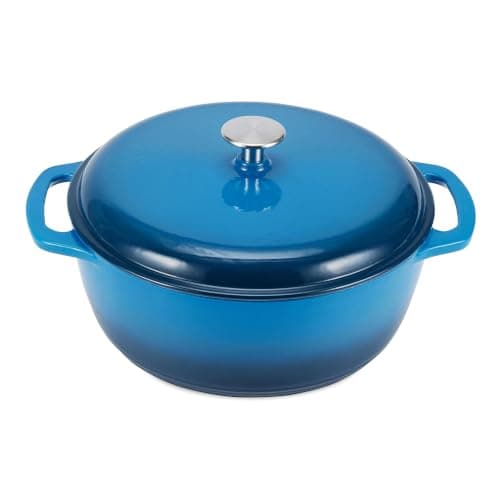
Budget pick — Amazon Basics Enameled Dutch Oven (6 qt)
Below $50 and it still bakes a respectable loaf. Quality control is more variable than Lodge — read recent reviews before buying — but for a first attempt at sourdough where you're not sure you'll keep at it, this gets you in the door for the cost of a takeout dinner.
- Capacity: 6 qt — same as the Lodge enameled.
- Pros: Half the price. Functionally identical for bread.
- Cons: Heavier-feeling enamel that can chip if banged. Color options dull faster. Lid knob plastic on some batches — check listings.
Buy this if budget is the binding constraint or you're not 100% sure sourdough will stick.
How to use a Dutch oven for sourdough (the basic protocol)
This protocol works for all four pots above. Adjust temps ±10°F based on your oven's accuracy.
- Preheat the empty pot (and lid) at 500°F for 30 minutes minimum. Stone-cold cast iron will sap the oven temp by 50°F when you load it.
- Score the proofed dough on parchment paper while the pot heats.
- Load. For Combo Cooker designs: lift out the shallow skillet (now scorching hot), set the parchment-and-dough onto it, lower the deep dome over the top. For round deep pots: lift the parchment into the well by the corners.
- Bake covered at 475°F for 20 minutes. The trapped steam is doing the work.
- Remove the lid and bake another 20–25 minutes at 450°F until the crust is deep mahogany and the internal temp reads 205–210°F.
- Cool on a wire rack for at least 45 minutes before cutting. Slicing hot bread tears the crumb and leaks moisture.
That's it. Same protocol whether the loaf is 600g or 1,000g — only the timing shifts a few minutes either way.
Sizing: 3-quart vs 5-quart vs 6-quart
| Loaf weight | Best pot size | Why |
|---|---|---|
| 500–750g | 3 qt (Combo Cooker) | Smaller volume keeps steam concentrated; less heat wasted. |
| 800–1,000g | 5 qt (Double Dutch) | Enough vertical room for spring without sprawl. |
| 1,000g+ or batards | 6 qt (Essential Enamel) | Footprint matters more than vertical for oblong loaves. |
The most common mistake: buying a 7-quart pot because "bigger is better." A boule baked in a too-large pot flattens sideways instead of springing up. The pot's wall actually shapes the loaf during the covered bake.
Care, seasoning, and rust prevention
Bare cast iron (Combo Cooker, Double Dutch):
- Wipe out crumbs with a dry paper towel. Don't soap-wash unless something's burned on.
- Dry on the still-warm stovetop for 5 minutes after every bake. Trapped moisture is what rusts these pots, not the bread.
- Re-season once a year: thin coat of neutral oil, upside-down in a 450°F oven for an hour. That's it.
Enameled cast iron (Essential Enamel, Amazon Basics):
- Cool fully before washing. Hot enamel + cold water = thermal shock = cracks.
- Don't drag metal tools across the interior. Wood, silicone, or plastic only.
- Never put the pot through a 500°F preheat with a plastic knob still attached. Swap for metal first if needed.
Done right, any of these four pots outlasts a 30-year mortgage.
What to do next
- How to bake sourdough in a Dutch oven: beginner's step-by-step — once the pot arrives, this is your first-loaf playbook.
- Best stand mixers for home bakers — the other major upgrade once you're committed to weekly bakes.
- Essential baking tools for starting a home bakery — what else belongs on the bench before you scale.
Related reading
- Best bakery packaging for small businesses — once your home bakes start going out the door.
Affiliate disclosure
Baker Setup is reader-supported. When you buy through links on our site, we may earn an affiliate commission at no extra cost to you. We only recommend products we've researched against the field — never sponsored placements.